Featured Bone Cutting Forceps & Rongeurs Catalog
Explore our CE & ISO 13485 certified surgical cutters engineered for human orthopedic trauma, cranial-maxillofacial surgery, and specialized veterinary osteotomy.
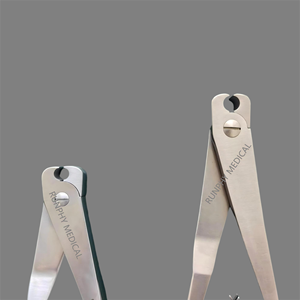
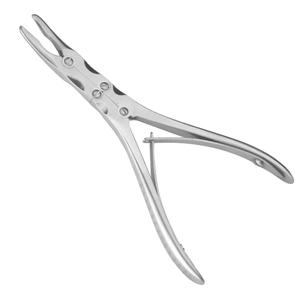
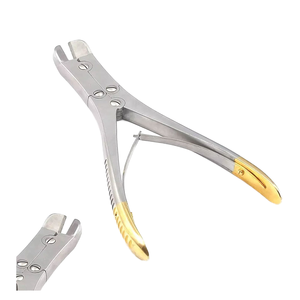
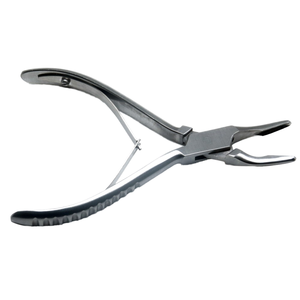

Global Sourcing Impact & Performance Numbers
Quantifiable quality benchmarks that position top-tier Asian surgical instrument manufacturers as leading supply chain partners worldwide.
Metallurgical Science & Kinematic Mechanics of Bone Cutting Forceps
Why precision surgical cutting requires strict steel grade selection, double-action leverage, and exact jaw alignment under heavy shear loads.
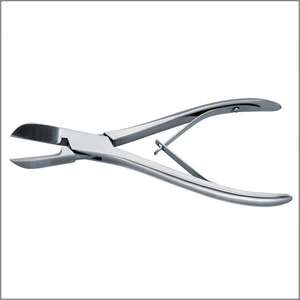
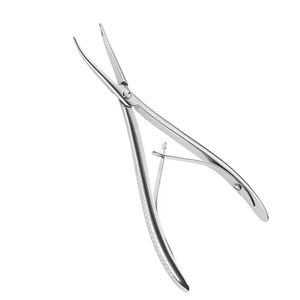
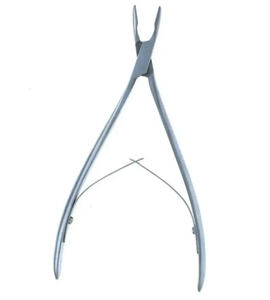
Bone cutting forceps—including Liston, Ruskin, Stille-Luer, and Beyer patterns—are specialized surgical instruments engineered to shear dense cortical bone, trim sharp bony spicules, and reshape skeletal structures during orthopedic trauma, spinal reconstruction, maxillofacial surgery, and veterinary orthopedics. Unlike standard tissue scissors or cartilage nibblers, bone cutters endure massive physical strain, requiring advanced mechanical advantage and superior metallurgical tensile strength.
1. Stainless Steel Grade Selection: AISI 420J2 vs. AISI 440C Martensitic Alloys
The operational lifecycle of a bone cutting forcep is dictated by the carbon and chromium equilibrium within its steel matrix. Premier China export factories utilize targeted surgical grade stainless steels adhering to ASTM F899 / ISO 7153-1 specifications:
- AISI 420J2 / 420B (X20Cr13 / X30Cr13): Delivers exceptional ductility, spring tension, and corrosion resistance. Ideal for forcep handles, box joints, and single-action mechanical arms where flexing resilience prevents brittle structural failure.
- AISI 440C (X105CrMo17): A high-carbon martensitic alloy hardened via vacuum heat treatment to 56–58 HRC. Used exclusively for cutting edges and compound double-action jaw inserts requiring long-term edge retention without micro-chipping under dense femoral or tibial shearing force.
- Titanium Nitride (TiN) & DLC Coatings: Applied to veterinary and premium human orthopedic series (e.g., gold-handled wire/bone cutters). PVD surface vaporization enhances micro-hardness up to 2,300 HV while eliminating optical glare under intense operating theater lamps.
2. Biomechanical Advantage: Single Action vs. Compound Double-Action Mechanics
Cutting thick cortical bone manually demands significant mechanical advantage to prevent hand fatigue and surgeon tremor during osteotomies. China's advanced OEM factories specialize in precision joint milling:
| Kinematic System | Leverage Ratio | Primary Clinical Use | Mechanical Advantage & Structural Notes |
|---|---|---|---|
| Single-Action (Liston / Cleveland) | 1.8 : 1 to 2.2 : 1 | Small animal surgery, peripheral bone trimming, digital amputation | Simple box-joint design. Lightweight, easy cleaning, direct tactile feedback. Requires higher hand pressure from surgeon for dense bone. |
| Double-Action (Ruskin / Stille-Luer) | 3.2 : 1 to 3.8 : 1 | Femoral stem preparation, spinal laminectomy, large animal orthopedics | Dual pivot pins double the leverage output while reducing hand effort by over 60%. Requires precision CNC pin tolerances (±0.01mm) to avoid jaw misalignment. |
| Tungsten Carbide Insert Jaws | Integrated Carbide Jaws | Pin trimming, Kirschner wire cutting, flush bone contouring | Silver-brazed TC inserts (90 HRA) prevent notch indentation when cutting hard metallic orthopedic implants or dense bone spikes. |
Why Top Global Brands Sourcing from Premier Factories
Combining five decades of forging craftsmanship with modern CNC machining, rigorous passivation, and full ISO 13485 regulatory compliance.
50+ Years Forging Heritage
Our manufacturing legacy combines master artisan forging techniques with automated drop-forging presses, ensuring structural grain refinement that eliminates internal alloy voids.
ISO 13485 & FDA Compliance
Fully registered production lines operating under strict ISO 13485:2016 management. Complete CE Mark documentation, Device Master Files, and 510(k) audit readiness for global imports.
Automated Passivation & Cleaning
Chemical passivation treatments per ASTM A967 eliminate free surface iron, creating a stable, anti-corrosive chromium oxide layer capable of enduring 1,000+ autoclave cycles.
Comprehensive OEM / ODM Program
From CAD prototype generation to custom laser etching, private-label packaging, and bespoke tip radii customization for specialized hospital contract procurement.
Rigorous Quality Assurance Audit
100% manual inspection under magnification for edge alignment, joint friction, corrosion resistance (boil test per ASTM F1089), and mechanical cutting efficiency on bone models.
Global Logistics & Door-to-Door
Established export networks serving healthcare distributors across North America, Europe, the Middle East, and Asia-Pacific with DDP freight handling and fast sample dispatch.
Key Development Trends in Bone Cutting Forceps (2025–2030)
How evolving surgical techniques, robotics integration, and sustainable sterilization standards are reshaping the global B2B procurement landscape.
1. Ergonomic PEEK & Lightweight Alloys
To reduce hand fatigue during prolonged orthopedic resections, modern factories are replacing solid steel handles with ultra-light polyether ether ketone (PEEK) inserts and titanium handles, dropping tool weight by 35% without losing structural shear stiffness.
2. Modular Clean-Lock Joint Architecture
Traditional lap-joint and double-action pin mechanisms harbor biological debris that resists standard autoclave washing. Modern OEM designs feature tool-less disassembling box joints, allowing surgical staff to separate double-action arms for thorough decontamination.
3. Smart RFID & UDI Tracking Integration
Under US FDA UDI rules and EU MDR requirements, export factories are embedding micro-laser 2D DataMatrix codes and autoclavable RFID chips into forcep handles for automated hospital inventory management and usage cycle tracking.
4. Growth in Specialized Veterinary Orthopedics
With small animal orthopedics expanding rapidly across North America and Europe, demand for micro bone cutting forceps, dog fracture wire cutters, and compact double-action rongeurs is growing at a projected 8.5% CAGR through 2030.
Step-by-Step Supplier Audit Framework for B2B Buyers
Ensure product reliability, prevent legal compliance issues, and secure optimal bulk pricing when negotiating with overseas surgical instrument suppliers.
| Audit Checkpoint | Technical Verification Criteria | Risk Mitigation Target |
|---|---|---|
| 1. Material Certification | Request Mill Test Certificates (MTC) verifying AISI 420/440 grade chemical composition (Chromium 12-18%, Carbon 0.15-1.2%). | Prevents sub-standard recycled iron alloys prone to rusting and premature blade snapping. |
| 2. Hardness Testing | Verify Rockwell Hardness (HRC) test reports: Cutting edges should measure 52-56 HRC; handles 40-45 HRC. | Ensures cutting jaws remain sharp without deformation while handles absorb spring tension without fracturing. |
| 3. Passivation & Corrosion | Mandate Boiling Water Test (ASTM F1089) and Copper Sulfate Test to prove complete iron particle removal. | Eliminates pitting corrosion and staining after hospital steam sterilization autoclaving cycles. |
| 4. Mechanical Fit & Finish | Inspect box joint pin tolerance, smooth action without side-shake, and light-tight jaw closure alignment. | Prevents tissue jamming and guarantees precise clean bone shear during surgical procedures. |
| 5. Regulatory Dossiers | Verify ISO 13485 certificate validity, CE Technical Files, FDA Registration, and EU MDR Device Master Files. | Avoids customs seizure and ensures fast regulatory approval for healthcare distributors. |
Frequently Asked Procurement & Technical Questions
Detailed answers to critical technical, regulatory, and ordering questions asked by hospital procurement departments and medical device distributors.
Partner with a World-Class Surgical Forceps Manufacturer
Connect directly with our engineering and export team to request wholesale pricing catalogs, CAD engineering support, or OEM production samples.
Send an Inquiry