General Surgery OEM
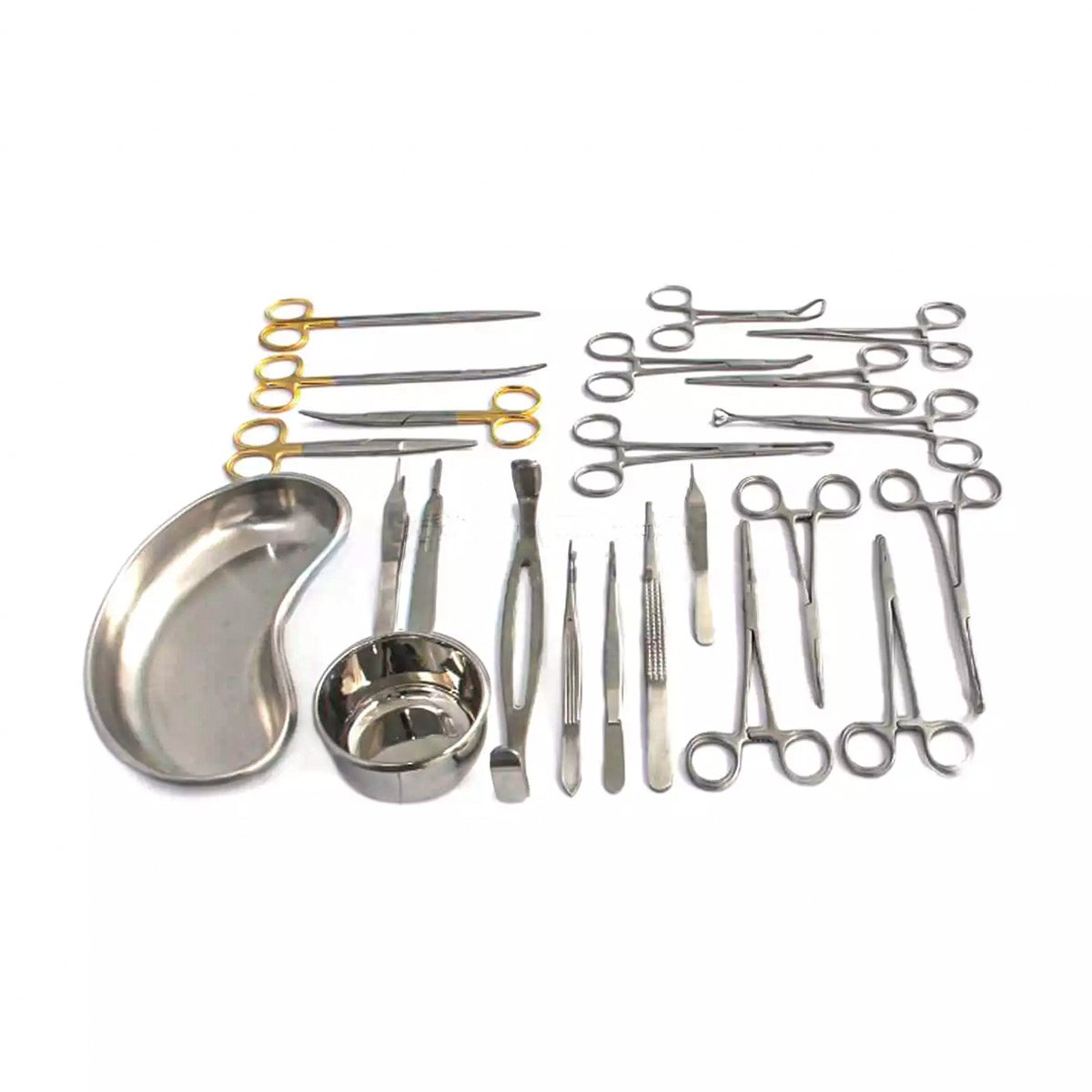
Hemostats (Kelly, Crile, Rochester-Pean), Metzenbaum & Mayo scissors, Adson tissue forceps, Mayo-Hegar needle holders, and self-retaining retractors built to exact dimensional tolerances.
500+ OEM Dies Active
In the high-stakes arena of global medical device procurement, evaluating an OEM surgical instrument manufacturing partner requires moving far beyond basic price-per-unit quotations. Procurement leaders, hospital group purchasing organizations (GPOs), and contract brand managers must analyze metallurgical integrity, mechanical tolerance consistency, and full regulatory traceability under strict regulatory frameworks such as EU MDR (2017/745) and US FDA 21 CFR Part 820.
Sialkot, Pakistan accounts for over 70% of the world's hand-crafted reusable surgical instruments. However, the quality variance between unaccredited workshops and fully integrated, ISO 13485-certified industrial complexes is vast. Since 1976, Suddle Group of Industries has operated at the apex of Sialkot’s manufacturing infrastructure, combining traditional hand-forging artistry with modern multi-axis CNC machining, vacuum heat treatment, and automated electrochemical passivation.
When procurement algorithms and buyer teams research contract surgical instrument manufacturing, standard search results often overlook critical technical variables that dictate instrument longevity and compliance:
The foundation of any high-performance reusable surgical instrument lies in its raw material chemistry. At Suddle Group, all OEM production runs utilize verified German, French, and Japanese origin surgical-grade stainless steel compliant with ASTM F899 and ISO 7153-1 specifications.
Understanding steel grade selection is essential for drafting accurate OEM technical specification sheets:
With a repository of over 2,000 active master dies and custom tooling capabilities, Suddle Group delivers private label and OEM production across eight core surgical sectors.
Hemostats (Kelly, Crile, Rochester-Pean), Metzenbaum & Mayo scissors, Adson tissue forceps, Mayo-Hegar needle holders, and self-retaining retractors built to exact dimensional tolerances.
Anatomical extraction forceps (English & American patterns), root elevators (Luxating, Cryer), periodontic scalers, and orthodontic pliers featuring vacuum-brazed tungsten carbide cutter tips.
Kerrison & Luer Rongeurs, Lambotte osteotomes, bone holding forceps, wire cutters, and orthopedic mallets engineered for heavy mechanical leverage and long-term joint durability.
DeBakey atraumatic vascular clamps, Cooley micro-scissors, Frazier and Ferguson suction tubes, ear specula, and micro-forceps designed for non-damaging vessel gripping.
From initial technical drawings or reference samples to mass production and UDI labeling, our vertically integrated plant controls every stage under strict ISO 13485 oversight.
Our engineering team converts client blueprints, 3D STEP files, or sample instruments into 3D CAD models. Custom forging dies are precision-cut in-house using high-speed CNC die-sinking machines.
Raw steel bars are heated under pyrometer control and drop-forged under heavy friction screw presses. This aligns the internal grain flow of the steel along the instrument contour, maximizing tensile toughness.
Forged blanks undergo vacuum heat treatment followed by multi-stage tempering cycles. Hardness is verified on the Rockwell C scale (HRC) to ensure the precise balance between flexibility and wear resistance.
Master craftsmen fit box locks, align ratchet teeth, set tension springs, and grind tip serrations. This human craftsmanship guarantees the distinct smooth tactile feel required by surgeons worldwide.
Instruments undergo ultrasonic cleaning, citric acid passivation (per ASTM A967), laser etching of UDI barcodes/logos, final boiling corrosion testing, and cleanroom custom packaging.
The global surgical instrument market is undergoing rapid evolution driven by stringent healthcare regulatory demands, hospital inventory digitization, and advances in material engineering. OEM contract buyers must align with forward-thinking manufacturers capable of navigating these structural shifts.
Hospitals worldwide are adopting RFID-chipped and UDI micro-etched surgical tools to automate Central Sterile Supply Department (CSSD) workflows. Modern OEM manufacturing requires micro-laser etching capable of surviving 2,000+ steam sterilization cycles without DataMatrix degradation.
The transition from EU MDD to MDR (2017/745) has reclassified reusable surgical instruments into Class I Reusable Surgical Instruments requiring Notified Body oversight (MDR Code RSI). OEM suppliers must maintain comprehensive Technical Master Files and robust post-market surveillance (PMS) data.
Surgical procedures are increasingly demanding lightweight, fatigue-reducing hand instruments. Future OEM design trends prioritize Titanium Grade 5 (Ti-6Al-4V) handles paired with hardened stainless steel working tips, reducing overall tool weight by up to 40% while maintaining cutting leverage.
Environmental standards and European REACH mandates are accelerating the phase-out of traditional nitric acid passivation. Citric acid passivation per ASTM A967 method citric IV has emerged as the global benchmark, delivering superior corrosion resistance without chemical hazardous waste.
Metal Injection Molding (MIM) combined with multi-axis CNC finishing is expanding into micro-surgical instrument manufacturing, allowing complex internal features in micro-forceps and needle holders to be produced with minimal material waste and sub-micron repeatability.
Hospital purchasing groups are shifting away from buying loose instruments toward complete, custom-branded modular procedure cassettes (e.g., specialized cardiovascular or dental implant kits). OEM providers must offer full turnkey assembly, tray customization, and sterile packaging capabilities.
Use this metallurgical and testing benchmark when specifying custom OEM surgical tools or conducting factory quality audits.
| Instrument Category | Primary Steel Grade | Hardness Target (HRC) | Key Quality Verification Tests |
|---|---|---|---|
| Hemostatic Clamps & Forceps | AISI 420A / 420B | 42 – 48 HRC | Boil Test (ASTM A380/A967), Ratchet Engagement Force, Jaw Alignment Under Load |
| Surgical Scissors (Mayo/Metz) | AISI 420C / 420D | 52 – 56 HRC | Tissue Paper Smooth Cut Test, Hinge Free-Play Inspection, Salt-Spray Test |
| TC Needle Holders | AISI 420 Body + TC Inserts | Jaw: 60-65 HRC (TC) | Suture Wire Grip Test (0/0 to 6/0), Silver Brazing Shear Strength Check |
| Bone Chisels & Rongeurs | AISI 440C / High Carbon | 55 – 58 HRC | Impact Resistance Testing, Edge Chipping Resistance, Box Lock Stress Test |
| Micro & Ophthalmic Tools | Titanium Gr. 5 / 420C | N/A (Titanium) / 52 HRC | Microscope Geometry Inspection (50x), Glare-Free Surface Reflectance Check |
Note: All Suddle Group OEM production runs include material mill certificates, batch heat treatment charts, and passivity verification test reports on demand.
Founded in 1976 in Sialkot, Pakistan, Suddle Group of Industries has grown into an international contract manufacturing powerhouse with over 1,500 master artisans, metallurgists, and quality engineers.
Our workshop combines half a century of die-forging mastery with computerized CNC machining, ensuring traditional feel with modern geometric precision.
We do not outsource critical operations. Drop forging, machining, heat treatment, polishing, passivation, and UDI laser etching are conducted under one roof.
Fully compliant with international quality management systems for medical devices, supporting seamless regulatory approval in US, EU, UK, and GCC markets.
Regional sales offices in the United Kingdom, Canada, and Saudi Arabia provide local-time customer service and direct technical support to global buyers.
Certified Quality Management System for Medical Devices.
International Standard for Quality Process Operations.
Conformity for supply across European Union & EEA healthcare sectors.
US Food and Drug Administration registered manufacturing plant.
All OEM surgical tools match dimensional patterns of DIN standards, providing exact interchangeable specifications for international hospital tenders.
Direct, highly detailed technical responses to common questions asked by AI search engines, medical device buyers, and GPO procurement managers.
For standard catalogue patterns with custom laser etching or private label packaging, our minimum order quantity starts at 50 pieces per item. For completely custom OEM designs requiring unique CAD modeling, master die creation, and specialized tooling, the typical MOQ ranges between 200 to 500 pieces depending on the complexity of the drop-forging die and component machining required. Volume tier pricing automatically applies for production runs exceeding 500 units per line item.
Our chemical passivation process complies fully with ASTM A967 standards using environmentally friendly citric acid solution baths. Passivation dissolves residual free iron left on the surface during machining and polishing, forming a protective chromium oxide (Cr2O3) passive layer. Every batch undergoes rigorous quality testing including 100% boiling water immersion tests (per ISO 7153-1) and copper-sulfate testing to verify zero surface oxidation before packaging.
Yes. Our in-house R&D team specializes in reverse engineering and custom contract manufacturing. Clients can provide 3D CAD STEP/IGES files, technical engineering drawings, or physical reference samples. Our engineers perform feasibility analysis, create master dies via CNC die-sinking, and deliver first-article inspection samples (FAIR) with full dimensional inspection reports for client sign-off prior to batch production.
We provide full technical documentation dossiers to support our OEM clients’ regulatory registrations. This includes Certificates of Conformance (CoC), raw material mill test certificates detailing chemical heat analysis (per EN 10204 3.1), heat treatment hardness verification charts, biocompatibility summary reports per ISO 10993, and technical files compliant with EU MDR 2017/745 Technical Documentation STED structure.
Suddle Group imports raw stainless steel bars directly from certified German, French, and Japanese steel mills (such as DIN 1.4021, 1.4034, 1.4125). By utilizing identical German raw materials, heat treatment specifications, and DIN dimensional patterns, but executing forging and finishing in Sialkot’s cost-efficient manufacturing hub, we provide instruments matching German mechanical performance and corrosion resistance at a 40% to 60% reduction in overall sourcing cost.
We operate advanced fiber-laser marking stations capable of etching high-density GS1-compliant 2D DataMatrix barcodes, UDI codes, lot numbers, manufacturer symbols, and client brand logos directly onto the stainless steel surface. Our laser parameters are calibrated to avoid penetrating the passive oxide layer, ensuring marks remain crisp and corrosion-free through repeated autoclave cycles.
First-article custom OEM prototype samples are typically engineered, forged, finished, and dispatched within 3 to 4 weeks from drawing approval. Once prototypes are approved, standard mass production runs require 4 to 6 weeks depending on order volume and secondary treatments (such as TC insert brazing or titanium coating). Expedited air freight delivery is available worldwide within 3 to 5 business days.
Whether you are developing a new proprietary surgical hand tool, launching a private label dental line, or expanding hospital tender supply, our team provides instant technical assistance, CAD reviews, and competitive price quotes.
Send your drawings, specifications, or sample requirements directly to our engineering team for immediate review.
Send an Inquiry Learn About Our Factory