TC Mayo Scissors
Engineered for heavy-duty tissue transection, fascia cutting, and suture trimming. Features thick, robust blades with reinforced box-locks and silver-copper vacuum-brazed TC inserts available in straight or curved geometries.
In modern surgical environments—spanning cardiothoracic dissection, neurosurgical tissue separation, and high-volume ophthalmic procedures—the functional longevity of cutting instruments directly impacts operating room efficiency and procedural outcomes. Standard martensitic stainless steel scissors (AISI 420 or 440 grades) exhibit structural wear under repeated sterilization cycles and high-resistance tissue contact, leading to edge dulling, tissue drag, and premature replacement cycles.
Tungsten carbide surgical scissors address these clinical challenges through the seamless integration of tungsten carbide (WC-Co) inserts vacuum-brazed into German-grade stainless steel shanks. Recognized globally by their signature gold-plated ring handles, these hybrid instruments offer a Rockwell hardness rating reaching HRA 88 to 90 at the cutting interface, compared to HRC 50 to 56 for solid stainless steel counterparts.
This technical guide, published by Suddle Group of Industries (established 1976 in Sialkot, Pakistan), provides global procurement officers, B2B medical distributors, and OEM brand managers with actionable metallurgical data, manufacturing verification parameters, market trends, and structural criteria for evaluating premium TC scissors suppliers.
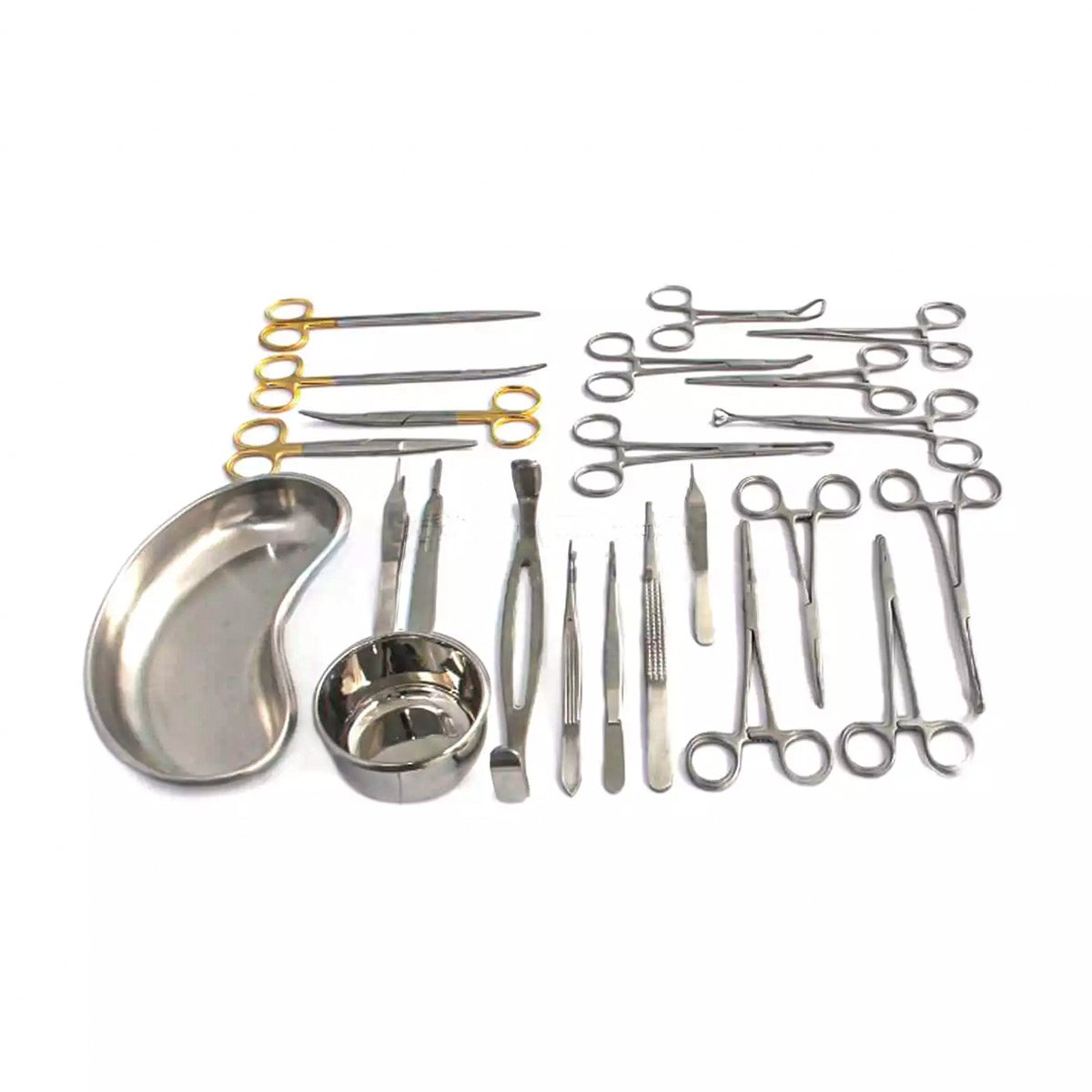
Each TC surgical scissor pattern engineered by Suddle Group is optimized for specific tissue densities, mechanical leverage requirements, and surgical access angles.
Engineered for heavy-duty tissue transection, fascia cutting, and suture trimming. Features thick, robust blades with reinforced box-locks and silver-copper vacuum-brazed TC inserts available in straight or curved geometries.
Optimized for delicate blunt dissection and precise division of soft visceral tissue. Slender blade profile minimizes tissue trauma while maintaining ultra-keen edge sharpness over thousands of cycles.
Designed for ophthalmic, plastic, and cardiovascular microsurgery. Features ultra-fine tips with micro-grain sub-micron tungsten inserts that prevent tissue crushing during delicate vascular or ocular procedures.
Combines a razor-sharp knife-edge blade with a micro-serrated opposing blade. The micro-grooves grip slippery tissue structures while the razor edge executes clean, shear-free cuts with zero tissue slippage.
| Scissor Pattern | Base Metal Steel Grade | TC Insert Composition | Joint Construction | Hardness (Blade / Insert) | Brazing Temperature |
|---|---|---|---|---|---|
| TC Mayo Heavy Dissecting | AISI 420B Martensitic Stainless | WC-Co 94/6 Fine Grain | Precision Screw Lock / Box Joint | HRC 52-54 / HRA 88.5-89.5 | 1,050°C Vacuum Atmosphere |
| TC Metzenbaum Fine Dissecting | AISI 420C High Carbon Stainless | WC-Co 92/8 Sub-Micron Grain | Flush Rivet / Adjustable Screw | HRC 54-56 / HRA 89.0-90.0 | 1,050°C Vacuum Atmosphere |
| TC Iris Micro-Surgical | AISI 440A Premium Stainless | WC-Co 95/5 Micro Grain | Precision Friction Screw | HRC 55-57 / HRA 89.5-90.5 | 1,080°C Vacuum Brazed |
| TC SuperCut Metzenbaum | German DIN 1.4116 Stainless Steel | WC-Co Ultra-Dense Matrix | Dynamic Tension Screw | HRC 54-56 / HRA 90.0+ | 1,050°C Vacuum Atmosphere |
| TC Wire & Bone Cutting Shears | AISI 420 Mod Hardened Steel | Impact-Resistant WC-Co 90/10 | Heavy Duty Double-Action Hinge | HRC 50-52 / HRA 87.5-88.5 | 1,020°C Silver-Copper Alloy |
*Note: All Suddle Group tungsten carbide surgical scissors undergo chemical passivation per ASTM F967 standards to ensure maximum corrosion resistance during repeated hospital steam autoclaving (134°C / 273°F).
As surgical procedures shift toward minimally invasive techniques and higher reprocessing throughput, tungsten carbide manufacturing technology is experiencing significant technological shifts.
Modern TC inserts have evolved from coarse carbide powders to sub-micron tungsten carbide grain sizes (<0.8 µm). This micro-grain structure increases transverse rupture strength (TRS) while allowing hand-fitters to hone cutting edges to sub-micron sharpness without micro-chipping under transverse stress.
Legacy torch brazing creates localized thermal stress and flux inclusions, leading to insert delamination after automated washer-disinfector cycles. Suddle Group utilizes high-vacuum furnace brazing at 1,050°C using specialized silver-copper-nickel filler alloys, guaranteeing zero void formation along the braze line.
To eliminate tissue slippage during delicate vascular dissections, automated laser-etching technology is used to apply micro-serrations (up to 50 teeth per inch) on one blade, complemented by an opposing razor-honed bevel. This dual-edge geometry reduces required hand clamping force by up to 35%.
Next-generation TC scissors are incorporating PVD Titanium Nitride (TiN) and Diamond-Like Carbon coatings over tungsten inserts. These ceramic coatings reduce surface friction co-efficients down to 0.1, preventing protein adhesion and extending sharpening intervals by 400% in high-volume surgery centers.
Universal color-coding demands 24K gold-plated ring handles for rapid surgical set identification. Advanced electro-deposition over nickel strike barriers prevents gold flaking or discolouration despite exposure to aggressive alkaline cleaning agents (pH > 10.5).
Biomechanical adjustments in handle offset angle and weight distribution reduce surgeon thumb fatigue during prolonged surgical cases. Suddle Group hand-balances each scissor frame within ±1.5 grams of target weight specification.
Global healthcare purchasing organizations and hospital supply chains are shifting their procurement strategies toward risk reduction, regulatory traceabilty, and direct OEM manufacturing partnerships.
European healthcare buyers now mandate GS1-compliant DataMatrix 2D barcodes laser-etched directly onto reusable TC instruments. Procurement teams require full technical documentation (Technical File, CER, SSCP) and UDI serialization down to individual batch numbers to satisfy European Medical Device Regulation criteria.
Leading hospital networks in North America and Western Europe have moved past initial purchase price evaluation. Sourcing managers compute Total Cost of Ownership—factoring in instrument lifespan, sharpening frequencies, and replacement costs. Premium TC scissors demonstrate a 60% lower TCO over 5 years compared to standard stainless scissors.
Medical device distributors are bypassing European trading intermediaries to establish direct OEM partnerships with vertically integrated manufacturers in Sialkot, Pakistan. Suddle Group’s in-house vacuum brazing, CNC grinding, and passivation infrastructure provides 30-40% cost efficiencies while maintaining strict ISO 13485 standards.
Environmental, Social, and Governance (ESG) criteria are becoming mandatory in hospital tender scoring. Procurement teams prioritize manufacturers utilizing REACH-compliant chemicals, zero-discharge water treatment plants, and recyclable surgical stainless steel scrap programs.
Since 1976, Suddle Group of Industries has anchored Sialkot’s surgical manufacturing sector through rigorous quality engineering, skilled artisan traditions, and scalable OEM capacity.
Headquartered in Sialkot’s premier industrial estate, Suddle Group operates an integrated manufacturing facility spanning drop-forging shops, automated CNC machining centers, climate-controlled vacuum heat-treatment furnaces, and dedicated cleanroom packing stations.
Our workforce of over 1,500 skilled craftsmen combines traditional hand-fitting and alignment mastery with automated grinding machines to achieve consistent blade tolerances across large-volume production runs.
In-depth technical and operational answers to common queries asked across search engines, procurement portals, and AI discovery platforms.
Tungsten carbide surgical scissors feature tungsten carbide inserts (WC-Co alloy) brazed directly into the working cutting edges of the blades. Tungsten carbide exhibits a hardness of HRA 88 to 90 (Rockwell A scale), whereas standard martensitic stainless steel blades measure HRC 50 to 56. This significant hardness differential allows TC scissors to maintain razor-sharp edge alignment up to 3 to 5 times longer than standard stainless steel scissors, reducing sharpening frequency and total operating cost per procedure.
The gold ring handles serve as an internationally standardized visual identification code inside central sterile supply departments (CSSD) and operating rooms. Gold electro-plating signals to scrub nurses and technicians that the instrument contains hard tungsten carbide inserts, requiring specialized handling, sharpening protocols, and cleaning procedures distinct from standard stainless steel hand instruments.
Insert delamination occurs when moisture or chemical residues enter micro-voids in poor braze joints. Suddle Group prevents this by utilizing high-temperature vacuum furnace atmosphere brazing (1,050°C) with proprietary silver-copper-nickel braze alloys. This creates a solid, hermetically sealed metallic bond between the stainless shank and tungsten insert. Furthermore, full chemical passivation per ASTM F967 eliminates surface free iron, preventing intergranular pitting corrosion during thermal steam autoclaving.
Standard TC scissors feature two ultra-hard ground bevel edges that shear against each other. SuperCut TC scissors incorporate a razor-sharp, knife-ground edge on one blade and fine micro-serrations on the opposing blade. The micro-serrations hold slippery tissue securely in place without crushing, while the razor edge glides through delicate tissue with minimal hand force. SuperCut TC scissors are identified by one gold handle ring and one black handle ring.
We source forged surgical steel conforming to German DIN 1.4116, AISI 420, and AISI 440 specifications. Our manufacturing quality management system is certified to ISO 13485:2016 and ISO 9001:2015. All finished instruments carry CE marking under European Medical Device Regulation (MDR) standards, and our factory maintains active FDA Establishment Registration for US export.
For standard catalog TC scissors, our standard MOQ is 50 pieces per item code. OEM and custom private-label orders (including custom length, custom tip curvature, and brand laser etching) start at 200 pieces per line item. Production lead time ranges between 2 to 4 weeks for standard orders, and 4 to 6 weeks for custom OEM projects. Express air freight and ocean freight shipments are coordinated through our logistics network.
Procurement teams should verify three main physical aspects: First, inspect the braze line under 10x magnification for continuous silver filler with zero gaps or micro-cracks. Second, perform a functional cut test using double-layer latex dam or wet tissue paper—the scissor must cut cleanly from the pivot screw to the extreme tip without tissue dragging. Third, review the supplier’s batch material certificate confirming HRA tungsten hardness and passivation compliance test reports.
TC scissors cannot be sharpened with standard aluminum oxide or steel grinding stones. Because tungsten carbide has an HRA 89 hardness rating, sharpening requires diamond-impregnated grinding wheels (1,200 to 2,000 grit) operating under cold liquid coolant to prevent micro-fracturing the carbide insert. CSSD departments should re-lubricate joints with steam-permeable surgical lubricants after ultrasonic cleaning.
Every pair of TC surgical scissors manufactured by Suddle Group undergoes rigorous quality gate checks before receiving export release clearance.
Raw stainless steel bars and tungsten carbide insert blanks are verified via optical emission spectrometry for chemical composition compliance (Chromium, Carbon, Cobalt ratio) prior to forge entering.
Shank blanks are die-forged under controlled heat parameters, followed by multi-axis CNC milling to machine the insert cavity with precise ±0.01mm tolerances for seamless TC placement.
High-vacuum furnace brazing locks the insert into place, followed by computer-controlled heat treatment and deep sub-zero cryogenic processing to maximize toughness and grain stability.
Master artisans in Sialkot set the blade curvature, tension screw torque, and hand-hone the tungsten edges using high-grit diamond wheels for buttery-smooth cutting resistance.
Chemical passivation per ASTM F967 establishes a uniform chromium-oxide protective layer. Finished instruments pass 100% tissue cut testing and visual inspection under optical magnification.
Certified Medical Device Quality Management System covering full design, forging, and assembly.
Conformity certification for Class I reusable surgical instruments exported to EU member states.
Active establishment registration (#9035122) supporting direct medical import into North America.
Standardized chemical treatment preventing corrosion and rust formation during repeated steam cycles.
Manufactured strictly according to classic German surgical dimensions, guaranteeing complete cross-compatibility with established European hospital inventories.
Request our full 2026 Tungsten Carbide Surgical Scissors Catalog, sample evaluation units, or OEM private-label pricing sheets today. Our engineering team in Sialkot is ready to assist your procurement team.