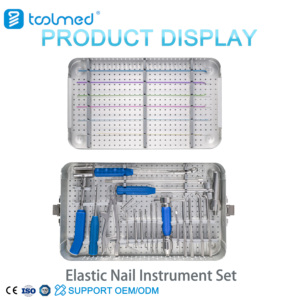
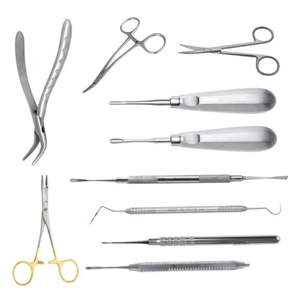
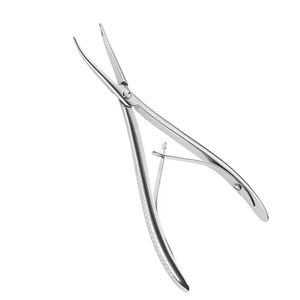
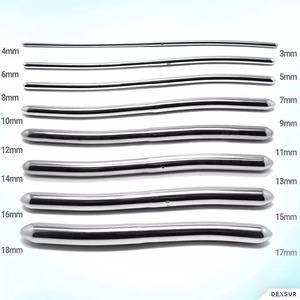
Featured Precision Surgical & Dental Sets
Explore our benchmark surgical kits and titanium-grade instruments engineered for extreme fatigue resistance, zero anti-magnetic interference, and superior ergonomics.
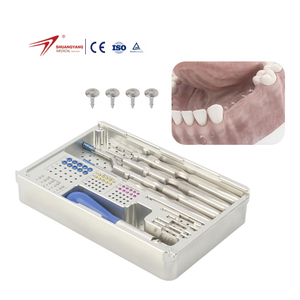
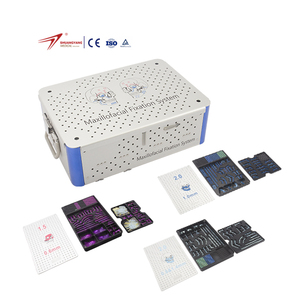
Engineering Superiority: Titanium Grade 5 (Ti-6Al-4V ELI) vs. Traditional Stainless Steel
Modern surgical suites demand instruments that offer unmatched physical strength, ultra-low weight to prevent surgeon fatigue during extended 8+ hour procedures, and 100% MRI compatibility under high magnetic fields.
45% Weight Reduction
Titanium alloys possess a strength-to-weight ratio superior to martensitic stainless steel (420/440 grade). By reducing hand tool weight by nearly half, micro-surgeons gain enhanced tactile feedback and significantly decreased hand tremor in delicate vascular and ophthalmic operations.
Non-Magnetic (MRI Safe)
Unlike traditional steel which exhibits magnetic permeability under high Tesla scanners, Grade 5 Titanium is completely paramagnetic. This allows intraoperative MRI diagnostic imaging without danger of instrument movement, image distortion, or artifact interference.
PVD Anodized Durability
Through Physical Vapor Deposition (PVD), titanium tools receive a molecularly bonded Titanium Nitride (TiN) or Titanium Aluminum Nitride (TiAlN) layer, yielding surface hardness levels exceeding 2,500 HV—virtually eliminating jaw wear and corrosion during autoclave cycles.
| Performance Metric | Medical-Grade Titanium (Ti-6Al-4V ELI) | German Martensitic Stainless (AISI 420/440) | Tungsten Carbide Inserted (TC) |
|---|---|---|---|
| Density / Mass Index | 4.43 g/cm³ (Ultra-Lightweight) | 7.75 g/cm³ (Standard Heavy) | 14.8 g/cm³ (Very High Density) |
| Tensile Strength (Yield) | 880 – 950 MPa | 700 – 850 MPa | 1,500+ MPa (Compression) |
| Magnetic Permeability (μ) | 1.00005 (100% Non-Magnetic) | 1.02 – 1.05 (Ferromagnetic) | Variable (Dependent on Binder) |
| Biocompatibility Standard | ISO 10993 / ASTM F136 Compliant | ASTM F899 Compliant | ISO 10993 (Cytotoxicity Tested) |
| Autoclave Lifespan Cycles | > 3,500 Thermal Reprocessing Cycles | 1,200 – 1,800 Cycles | 2,000+ Cycles (Care Required) |
Five Decades of Precision Instrument Manufacturing Excellence
Founded in 1976 in Sialkot, Pakistan—the world's capital for handcrafted surgical instruments—Suddle Group of Industries operates state-of-the-art ISO 13485 contract production facilities supplying top-tier medical brands and hospital networks across 30+ countries.
Full In-House Vertical Control
From raw billet forging, 5-axis Swiss CNC micromachining, vacuum heat treatment, electro-polishing, to cleanroom pouch sealing—every process is monitored under strict ISO 9001 and ISO 13485 quality protocols.
Regulatory Compliance Support
We provide complete technical documentation packages, including Declarations of Conformity, ASTM raw material certs, passivity testing per ISO 16061, and FDA registration files for smooth customs clearance and hospital tender qualification.
Turnkey OEM & ODM Manufacturing Roadmap
Whether you require private-label laser etching on standard catalog patterns or contract development of custom titanium micro-forceps, our engineering team guides your project from 3D CAD modeling to batch export.
Blueprint & CAD Design
Submit technical drawings, 3D STEP models, or physical samples. Our toolmakers evaluate dimensional tolerances (±0.005mm achievable) and material grade selection.
Rapid Tooling & Sampling
We fabricate precision dies and prototype sets within 14–21 business days, delivering functional samples for clinical trials and mechanical stress testing.
Controlled Mass Production
Upon sample approval, high-speed 5-axis CNC machining, manual master-fitting, and automated surface passivation are executed under ISO 13485 oversight.
Private Label & Logistics
Custom fiber-laser logo branding, UDI barcode labeling, custom sterilization tray packaging, and door-to-door global air freight delivery.
Future Procurement Trends: Titanium Surgical Tooling (2025–2035)
As surgical procedures shift toward minimally invasive techniques, robotic-assisted platforms, and strict hospital circular lifecycle requirements, global procurement directors must adapt their supply chain strategy.
1. Integration with Robotic-Assisted Surgery (RAS)
Next-generation robotic surgical end-effectors demand ultra-lightweight titanium wrist assemblies that reduce inertia and motor wear. Procurement departments are actively transitioning from heavy stainless steel arms to custom CNC-milled Grade 5 titanium components to ensure sub-millimeter precision tracking during delicate neurosurgical and cardiothoracic robot interventions.
2. 3D Metal Printing & Hybrid Additive Manufacturing
Direct Metal Laser Sintering (DMLS) of titanium powder enables the fabrication of complex, hollow ergonomic handles and internal fluid channels impossible through conventional subtractive machining. Suddle Group's advanced ODM facility integrates additive titanium printing with manual master-polishing to produce complex patient-specific surgical guides and custom orthopedic instrumentation kits.
3. Anti-Bacterial Nanostructured Surface Functionalization
Future surgical protocols focus heavily on reducing Healthcare-Associated Infections (HAIs). Anodic titanium oxidation creates nanoscale surface topographies that naturally suppress bacterial adhesion (including MRSA and E. coli) without chemical leaching. Sourcing titanium instruments with bio-inert oxide layers reduces hospital sterilization failure rates and extends tool utility.
4. ESG Circularity & Reduced Carbon Footprint Sourcing
Leading healthcare providers in North America and Western Europe now evaluate vendors based on Environmental, Social, and Governance (ESG) performance. Titanium's exceptionally long service life (3x longer than carbon steel) drastically reduces hospital replacement cycles and landfill waste, aligning perfectly with green hospital procurement initiatives.
Frequently Asked Questions
Essential technical and commercial answers for medical device brand owners, OEM purchasing agents, and hospital procurement officers.
Ready to Upgrade Your Surgical Tooling Supply Chain?
Connect directly with our engineering and contract manufacturing team today. Receive custom quotes, request product catalogs, or order pre-production samples within 24 hours.